Wirelio
Neon Pathway
Neon Pathway
Couldn't load pickup availability
Self-paced learning overview
- 📥 Digital file available after purchase
- 📚 Long-term availability
- 🔒 Secure checkout
- 🗓️ Content updated in 2026
1. Problem Statement
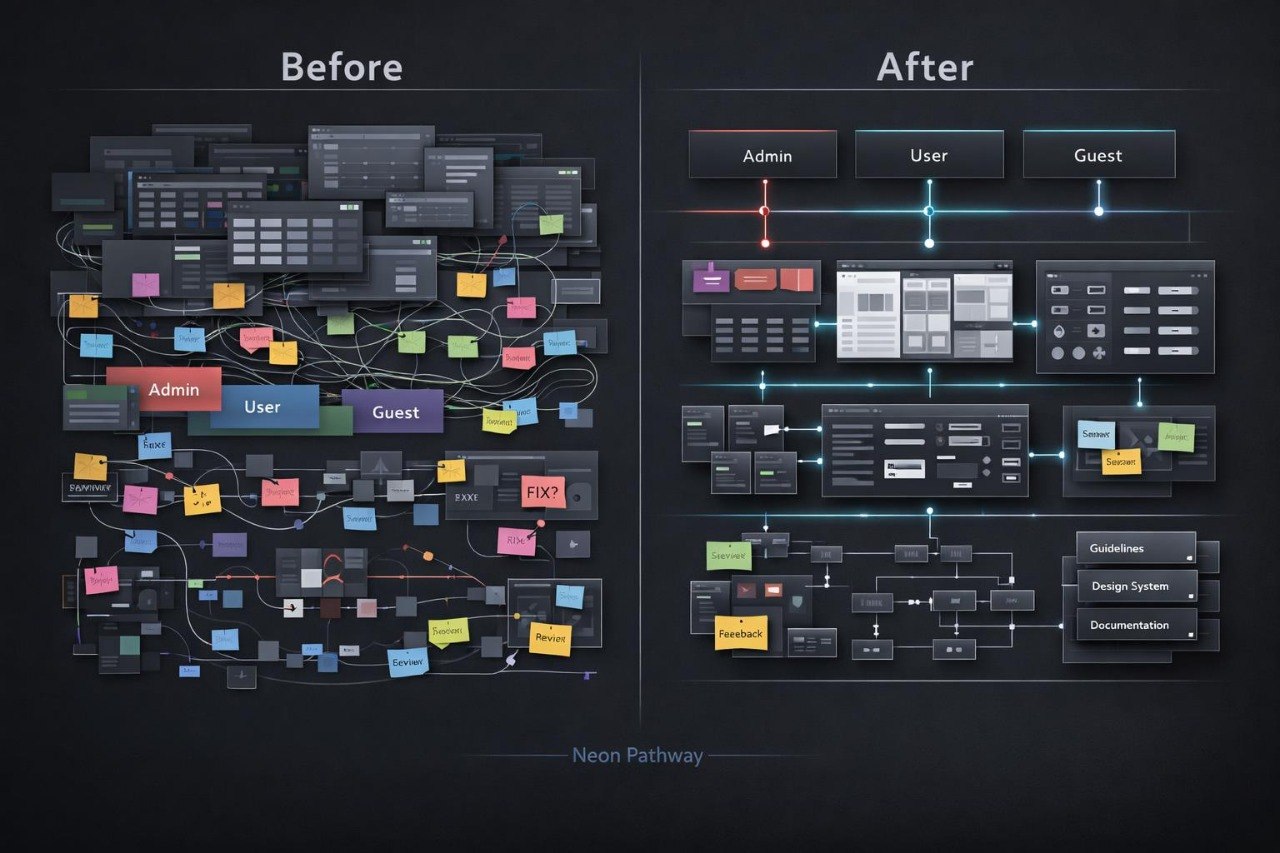
Struggling to maintain interface logic when a project contains many sections, roles, and connected actions? You are not alone: as the scope grows, even carefully prepared screens may begin to conflict with one another. Components may be used differently, routes can become repetitive, labels may change, and individual decisions may lose their connection to the original research. It can also become difficult to explain why a certain element appears or behaves in a particular way. Neon Pathway helps you build a clear system of rules, examine it across several scenarios, and prepare documentation for continued project work.
2. Solution
This course will teach you how to organize a large UI/UX assignment through sequential stages and clearly defined materials. You will examine how to prepare a research plan, arrange content, create complex routes, and maintain component consistency. The materials explain how to review decisions for different user roles, interaction contexts, and possible departures from the primary scenario. Practical assignments help you record revisions, compare versions, and describe element usage rules. After completing the course, you will be able to prepare a large study project containing connected screens, a prototype, a component library, and structured process documentation.
3. What’s Inside
Module 1: Project Framework and Planning
Define the topic, boundaries, user groups, primary scenarios, required materials, and sequence of project stages.
Module 2: Layered User Research
Prepare research questions, examine context, group observations, and identify differences between user roles.
Module 3: Service Structure and Content Logic
Create a multi-level section map, review labels, identify repetition, and define relationships between primary and supporting content.
Module 4: Multi-Route User Flows
Build several routes containing decision points, return paths, confirmation stages, error states, and alternative actions.
Module 5: Wireframe System
Prepare frameworks for central screens while maintaining a consistent structure across related project areas.
Module 6: Visual Language
Define typography, color roles, spacing, grids, visual hierarchy, and the appearance of information states.
Module 7: Component Architecture
Create component groups and describe their variations, states, behavior, and combination rules.
Module 8: Complex Prototype Building
Connect screens into a prototype containing several scenarios and structured transitions.
Module 9: Structured Review Sessions
Prepare review tasks, document participant actions, and organize observations by topic and importance.
Module 10: Revision Strategy
Set an order for revisions, update structures, routes, and components, and record the reasoning behind each change.
Module 11: Design Documentation
Prepare usage rules, examples, state descriptions, and notes for central interface elements.
Module 12: Neon Final Project
Combine research, a service map, scenarios, wireframes, styled screens, a prototype, components, and final documentation.
4. Who Is This For?
✅ A good fit if you:
- have already worked on complete UI/UX projects;
- understand research, structure, prototypes, and components;
- want to organize complex screen systems;
- are prepared to review and revise early decisions;
- would like to document interface processes and rules.
❌ Not for you if you:
- are only beginning to study basic UI/UX concepts;
- need a brief introductory course;
- do not plan to complete a large final project;
- expect a defined employment, financial, or commercial outcome.
5. What You’ll Learn
- prepare a plan for a large UI/UX project;
- describe the needs of at least four user groups;
- build a service map with several hierarchy levels;
- create four or more connected user routes;
- prepare wireframes for twelve or more screens;
- build a library containing at least ten components;
- describe element states, variations, and behavior;
- prepare tasks for a structured prototype review;
- organize observations by topic and importance;
- maintain a revision record between project versions;
- create documentation for central interface rules;
- complete one large UI/UX study project.
6. 30-Day Refund Policy
Neon Pathway includes a 30-calendar-day period for submitting a refund request under the Wirelio store rules. The review considers the purchase date, the amount of material already used, and the other conditions stated on the refund policy page. Please read the complete policy carefully before placing an order.
7. Certificate
A digital Wirelio certificate is issued after all required modules and the final project assignment have been completed. It records completion of the Neon Pathway course materials and the related study tasks.
1. What format do Wirelio courses use?
1. What format do Wirelio courses use?
The courses contain sequential modules, written explanations, visual examples, practical exercises, and materials for independent study. Learners can work through the content at their own pace and revisit earlier topics when needed.
2. Do I need previous UI/UX design experience?
2. Do I need previous UI/UX design experience?
The introductory plans are suitable for people who are new to UI/UX design. Higher plans include additional assignments, scenarios, and topics, so reviewing the individual course description can help you select a suitable option.
3. How are the Wirelio plans different?
3. How are the Wirelio plans different?
The plans are arranged according to the amount and depth of the included materials. Higher options may contain additional modules, exercises, templates, interface examples, and subjects for independent study.
4. Is a certificate included?
4. Is a certificate included?
Yes. A Wirelio certificate is issued after all required modules and assignments have been completed. It confirms participation in the learning program but does not represent a government-issued diploma or formal occupational qualification.
Share