Wirelio
Delta Pathway
Delta Pathway
Couldn't load pickup availability
Self-paced learning overview
- 📥 Digital file available after purchase
- 📚 Long-term availability
- 🔒 Secure checkout
- 🗓️ Content updated in 2026
1. Problem Statement
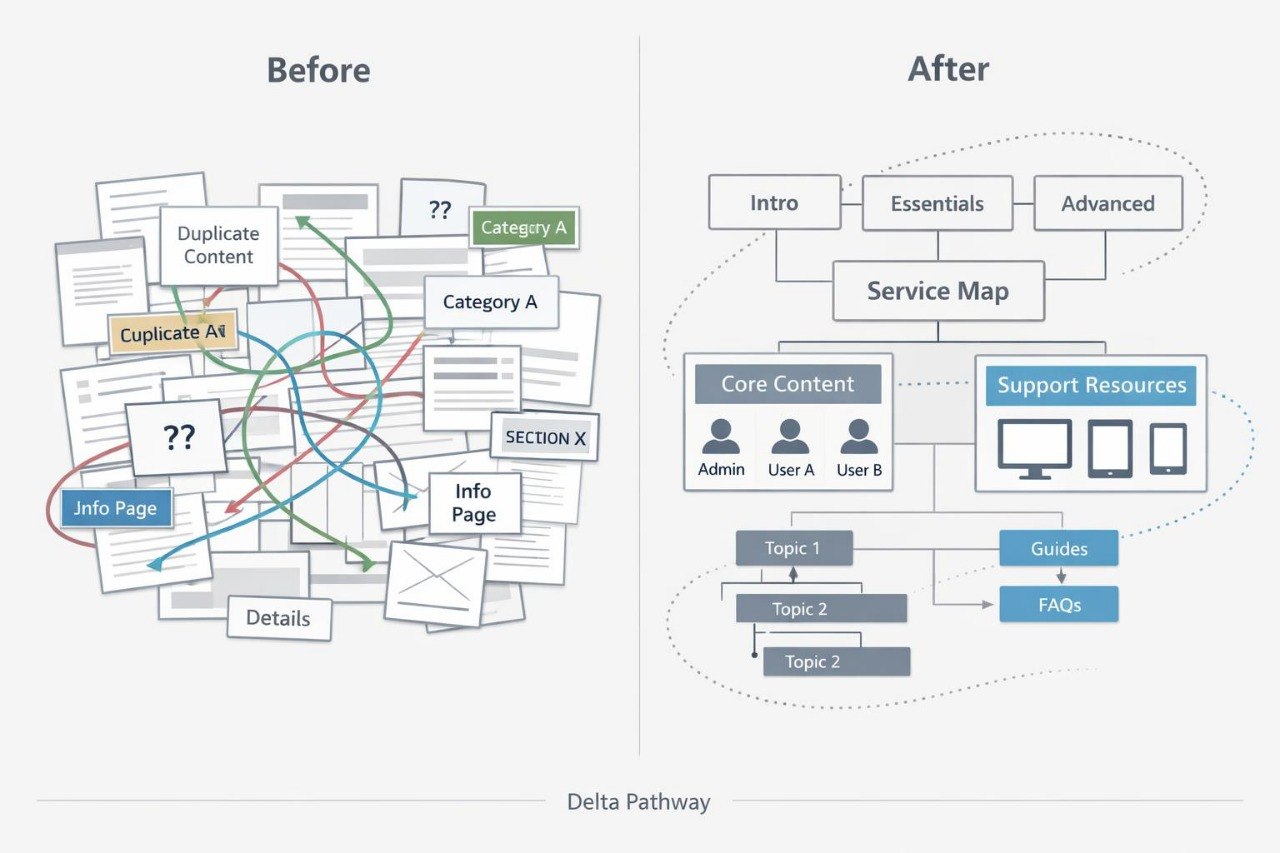
Struggling to organize an interface containing many pages, functions, and possible actions? You are not alone: as the number of sections grows, the structure can become confusing and user routes may overlap without clear reasoning. The same information may appear in several places, section labels may not reflect their content, and central actions may become difficult to notice among supporting elements. Individual screens can look organized while the wider system still feels disconnected. Delta Pathway explains how to divide a complex task into clear layers, examine the links between them, and document each major decision.
2. Solution
This course will teach you how to build information architecture for a digital service containing several central scenarios. You will study methods for grouping content, creating navigation models, and defining relationships between pages. The materials explain how to account for different user roles while reducing unnecessary repetition within the structure. Practical assignments guide you through reviewing section labels, action priorities, transitions, and component behavior across different screen widths. After completing the modules, you will be able to prepare a connected service map, a linked prototype, and a document explaining the central design decisions.
3. What’s Inside
Module 1: Defining Service Scope
Define the boundaries of a study project, its main user groups, central tasks, and the content that belongs within the structure.
Module 2: Content Inventory
Prepare a list of pages, functions, messages, and supporting materials while identifying repeated content and missing areas.
Module 3: Information Architecture
Group related topics, create levels of hierarchy, and prepare a complete map of the selected digital service.
Module 4: Navigation Models
Compare several navigation approaches and define how users move between primary and supporting sections.
Module 5: Multiple User Roles
Examine differences between the goals, actions, and information needs of several user groups.
Module 6: Complex User Flows
Create connected scenarios containing decision points, return paths, confirmation stages, and alternative routes.
Module 7: Responsive Structure
Study how hierarchy, navigation, and components can change across screen widths while retaining a consistent structure.
Module 8: System Review
Review labels, transitions, repeated elements, interface states, and consistency across different areas of the service.
Module 9: Delta Project Assignment
Prepare a service map, several connected routes, a group of central screens, and a focused document explaining your decisions.
4. Who Is This For?
✅ A good fit if you:
- have already worked with research, prototypes, and visual systems;
- want to design services containing many connected sections;
- would like to study information architecture in greater detail;
- want to account for several user roles;
- are prepared to document structure and design reasoning.
❌ Not for you if you:
- are only beginning to explore UI/UX design;
- only want material related to decorative styling;
- do not plan to work with larger maps and user routes;
- expect a defined employment or commercial outcome.
5. What You’ll Learn
- prepare a content inventory for a digital service;
- create a structure containing three or more hierarchy levels;
- describe the needs of at least three user groups;
- build three connected user routes;
- identify repeated content and structural gaps;
- define primary and supporting navigation;
- adapt interface structure across different screen widths;
- document component states, transitions, and usage rules;
- complete one connected study project containing several scenarios.
6. 30-Day Refund Policy
Delta Pathway includes a 30-calendar-day period for submitting a refund request under the Wirelio store rules. The review considers the purchase date, the amount of material already used, and the conditions listed on the refund policy page. Please read the complete policy before placing an order.
7. Certificate
A digital Wirelio certificate is issued after the required modules and final project assignment have been completed. It records completion of the Delta Pathway course materials.
1. What format do Wirelio courses use?
1. What format do Wirelio courses use?
The courses contain sequential modules, written explanations, visual examples, practical exercises, and materials for independent study. Learners can work through the content at their own pace and revisit earlier topics when needed.
2. Do I need previous UI/UX design experience?
2. Do I need previous UI/UX design experience?
The introductory plans are suitable for people who are new to UI/UX design. Higher plans include additional assignments, scenarios, and topics, so reviewing the individual course description can help you select a suitable option.
3. How are the Wirelio plans different?
3. How are the Wirelio plans different?
The plans are arranged according to the amount and depth of the included materials. Higher options may contain additional modules, exercises, templates, interface examples, and subjects for independent study.
4. Is a certificate included?
4. Is a certificate included?
Yes. A Wirelio certificate is issued after all required modules and assignments have been completed. It confirms participation in the learning program but does not represent a government-issued diploma or formal occupational qualification.
Share